

 From the Daily Mining Gazette, By Dan Schneider, DMG Writer
HOUGHTON -- A layer of packed snow covered M-26 from Ripley to Lake Linden.
M-203 running along Lake Superior and the Portage Lake Shipping Canal down into Hancock was mostly white.
"We haven't seen dry pavement since we left Houghton," Todd Cimermancic said.
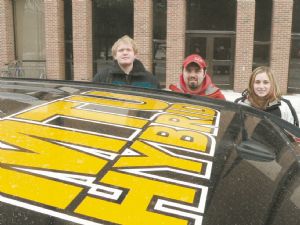
Behind the wheel of a 2005 Chevrolet Equinox he and a team of Michigan Technological University students have modified into a gas/electric hybrid, Cimermancic wasn't criticizing local plow crews. He was just pointing out the reality of the conditions their vehicle--they call it the "Huskynox"--needs to perform in.
Tech's Team is one of 17 from universities around the country competing in Challenge X.
Sponsored by General Motors, which provided the Equinox that's now the Huskynox, and the U.S. Department of Energy, Challenge X is a contest that pushes engineering students to find a way to make their vehicles more environmentally-friendly without compromising performance.
This is the final year of the four-year competition. Teams focused on design in the first year and took delivery of the vehicles in the second.
Their goal is to improve the vehicles' fuel economy by 30 percent and cut emissions by half.
"There really aren't any restrictions on how you can do that other than you have to implement your own powertrain," team leader Cimermancic said.
Tech's Challenge X team chose a parallel-through-the-road hybrid setup to move the Huskynox. That means the vehicle has separate powertrains for the front and rear axles, with the only mechanical connection between them being through the road.
To power the front wheels, they swapped out the Equinox's stock 3.4 liter V-6 in favor of a 2.0-liter Ford four-cylinder. In back, a Solectria 55-kilowatt AC induction motor hooked to a 288-volt battery pack gives the Huskynox its go.
"We're integrating the two power plants into the car and programming them to work together," Cimermancic said.
The idea is to make the car run mostly on electricity driving around town. The gasoline engine kicks in during acceleration and hill climbs and takes over at highway speeds.
When the car decelerates, the electric motor converts torque from the rear wheels into voltage in the battery pack.
An electronic control system orchestrates all of this. Tinkering the quirks out of that system is the team's current challenge, especially teaching the car to deal with snow.
Cruising the copper towns Thursday, the car would occasionally stutter as the control system tried to make its mind up whether to pull power from the battery or put it back in. Slippery road conditions make it difficult for the system to determine what's happening with the torque at the rear wheels.
"We're not quite calibrated perfectly for the changes in traction related to snow," Cimermancic said.
The Huskynox team faces elemental challenges foreign to competitors farther south. But Cimermancic said the team's goal is to make the vehicle perform in real-world driving conditions.
"One of the biggest things for our team is the snow," he said. "A lot of the teams will never drive their vehicles in the rain, let alone 8 inches of snow, which is the deepest snow we've driven in."
Some of the changes the team has made to the car are more subtle than the new twin powertrain.
Billy Bland, a fourth-year mechanical engineering student who was riding in the back seat of the Huskynox Thursday said when he joined the team, he "started out fixing a bunch of the wiring on the car, put new axles on it, designed a new gas tank and got that ordered."
The gas gauge on the dashboard no longer has anything to do with gas. Team Huskynox rigged it to the battery pack to give a general idea of its charge level. More in-depth system monitoring is done by a laptop computer stashed next to the center console.
"For the most part, driving around every day, the gauges do enough to show us what's going on," Cimermancic said.
Pulling the hill from Lake Linden up to Calumet, the gauge's needle marched steadily counterclockwise. But after a few blocks of town driving in Laurium, it was up to a quarter-tank of voltage.
"The biggest gains in fuel economy come in town, under 45 miles per hour," Cimermancic said.
As he slowed to turn onto M-203 northeast of Calumet, the electric motor whirred and the needle moved clockwise. The gauge showed the battery's charge was just about full.
"It takes very little to change the state of the battery pack," Cimermancic said.
Cruising a flat stretch of M-203 west of Calumet at about 50 mph, the Huskynox was just about silent, running only on the electric motor.
All the while, the computer recorded what was going on. Mindy Saxton, a second-year mechanical engineering student who was also riding in the back seat Thursday, crunches numbers for the team.
"We log our fuel economy and stuff like that," she said. "We have to keep a log of how far we drive, what kind of fuel we use."
The team is close to its goal for fuel economy. They've recorded miles per gallon in the mid- to high-20s for town driving. A stock 2005 all-wheel-drive Equinox gets about 16 miles per gallon in town.
On the highway, where the Huskynox relies solely on its gas engine for propulsion, Cimermancic said fuel economy runs a little shy of the stock Equinox's 22 miles per gallon.
The team has ordered a new catalytic converter to cut down on emissions, but will have to wait until the final round of competition in May to get access to the equipment needed to test its effect.
Performance numbers for the Huskynox closely mirror those of the stock vehicle, Cimermancic said. For instance, both vehicles do zero to 60 in about 10 seconds.
He said the team's goal is to make the Huskynox feel like a gently-used vehicle to the driver, even though the car will be three years old by the time the team travels to the final stage of the competition in New York in May.
They plan to install cameras and microphones at various locations on the car to find the sources of vibrations and rattles.
By May, they want the Huskynox to compare favorably with an actual production car.
Along M-203 Thursday, Cimermancic slowed to see if a pair of motorists stopped on the shoulder needed assistance. Turned out they were just parked there while they took a hike in McLain State Park.
As he drove off, he made note of the type of car they were driving.
"It's a Toyota Prius, a competitive hybrid," he said.
Dan Schneider can be reached at dschneider@mininggazette.com